ORTools alphabetical function index
ORTools alphabetical function index
C
computeBainGrains
This function computes the Bain group IDs of child grains.
- Syntax
- [bain_grains] = computeBainGrains(job)
- Input
- job - @parentGrainReconstructor
- Output
- bain_grains - @grains2d
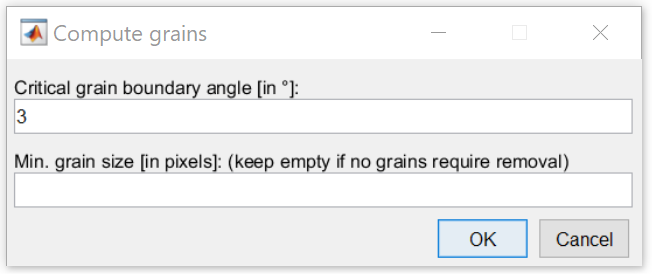
computeGrains
This function is a GUI to compute grains from ebsd map data and optionally filters them.
- Syntax
- [ebsd,grains,gB] = computeGrains(ebsd)
- Input
- ebsd - @EBSD
- Output
- ebsd - @EBSD
- grains - @grains2d
- gB - @grainBoundary
computeGrainPairs
This function computes the absolute or normalised frequency and boundary segment lengths of grain pairs. The grain pair ids can be defined by the user for variants, crystallographic packets, Bain groups, any other-id type or for groups of id or equivalent id pairs.
- Syntax:
-
[out] = computeGrainPairs(grains)
-
Input:
-
pairGrains - @grain2d = child grain pairs as computed by the computeVariantGrains function
-
Output:
-
out - @struc = a strcture variable containing the absolute or normalised frequency and boundary segment lengths of grain pairs.
-
Options:
- variant - Uses the variant ids of child grain pairs.
- packet - Uses the packet ids of child grain pairs.
- bain - Uses the bain ids of child grain pairs.
- other - Uses a pre-specified list of ids of child grain pairs.
- group - A cell defining different groups of id or equivalent id pairs. Use the computeVariantPairGroups function to derive the complete set of groups automatically.
- labels - A cell of x-axis labels, one per group, used when plotting groups of id or equivalent id pairs. Labels are composed from the id pairs themselves if not specified.
- include - Includes similar neighbouring variant, packet, bain, other-id type, groups of id or equivalent id pairs. For e.g. - V1-V1, or CP2-CP2, or B3-B3 etc.
- exclude - Excludes similar neighbouring variant, packet, bain, other-id type, groups of id or equivalent id pairs. (default)
- absolute - Returns the absolute frequency and boundary segment values of neighbouring variant, packet, bain, other-id type, or groups of id or equivalent id pairs.
- normalise - Returns the normalised frequency and boundary segment values of neighbouring variant, packet, bain, other-id type, groups of id or equivalent id pairs. (default)
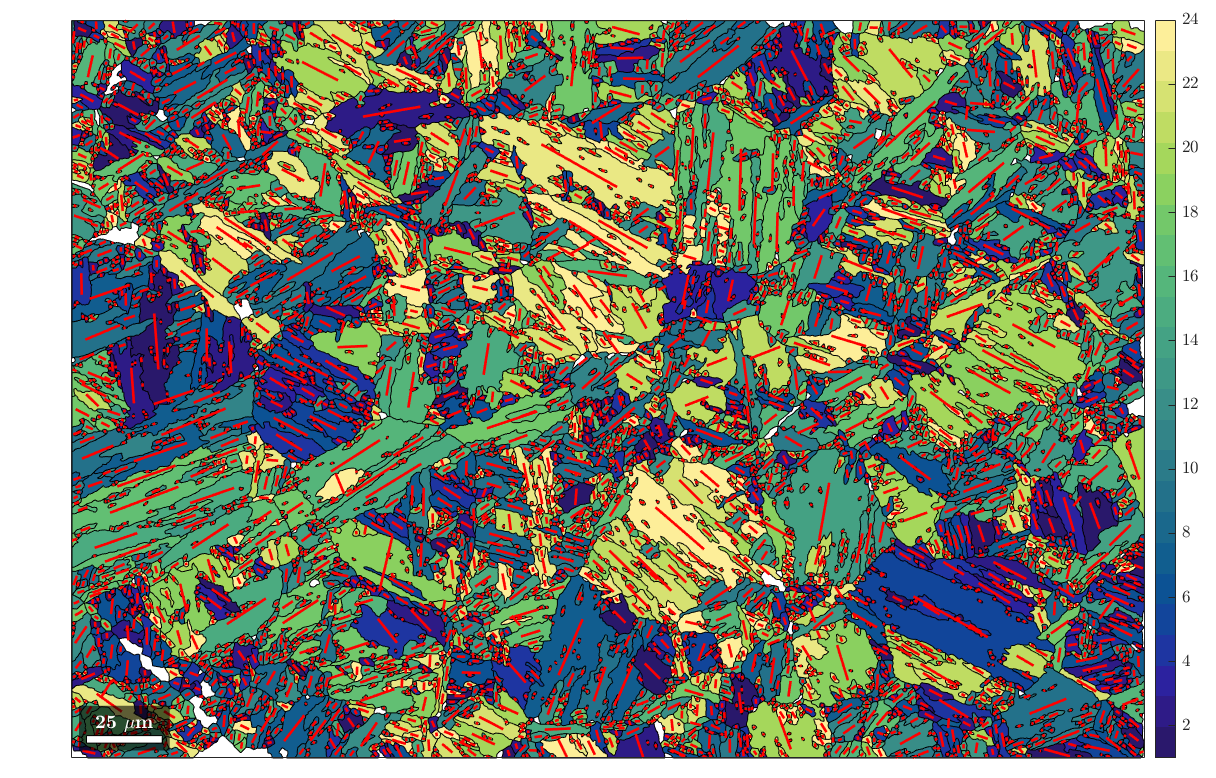
computeHabitPlane
This function computes the habit plane based on the determined traces from 2D ebsd map data as per the following reference:
- Syntax
- [hPlane,statistics] = computeHabitPlane(job)
- Input
- job - @parentGrainReconstructor
- Output
- hPlane - @Miller = Habit plane
- statistics - @Container = Statistics of fitting
- Options
- Radon - Radon based algorithm (ebsd pixel data used)
- Fourier - Fourier based algorithm (ebsd pixel data used)
- Calliper - Shortest calliper based algorithm (grain data used)
- Shape - Characteristic grain shape based algorithm (grain data used)
- Hist - Circular histogram based algorithm (grain data used)
- minClusterSize - Minimum number of pixels required for trace determination (default = 100)
- reliability - Minimum value of accuracy in determined traces used to compute the habit plane (varies from 0 to 1, default = 0.5)
- colormap - Defines the colormap to display the variants (default = haline)
- linecolor - Defines the linecolor of the plotted traces (default = red)
- noScalebar - Remove scalebar from maps
- noFrame - Remove frame around maps
- plotTraces - Logical used to plot the trace & habit plane output
computePacketGrains
This function computes the crystallographic packet IDs of child grains.
- Syntax
- [packet_grains] = computePacketGrains(job)
- Input
- job - @parentGrainReconstructor
- Output
- packet_grains - @grains2d
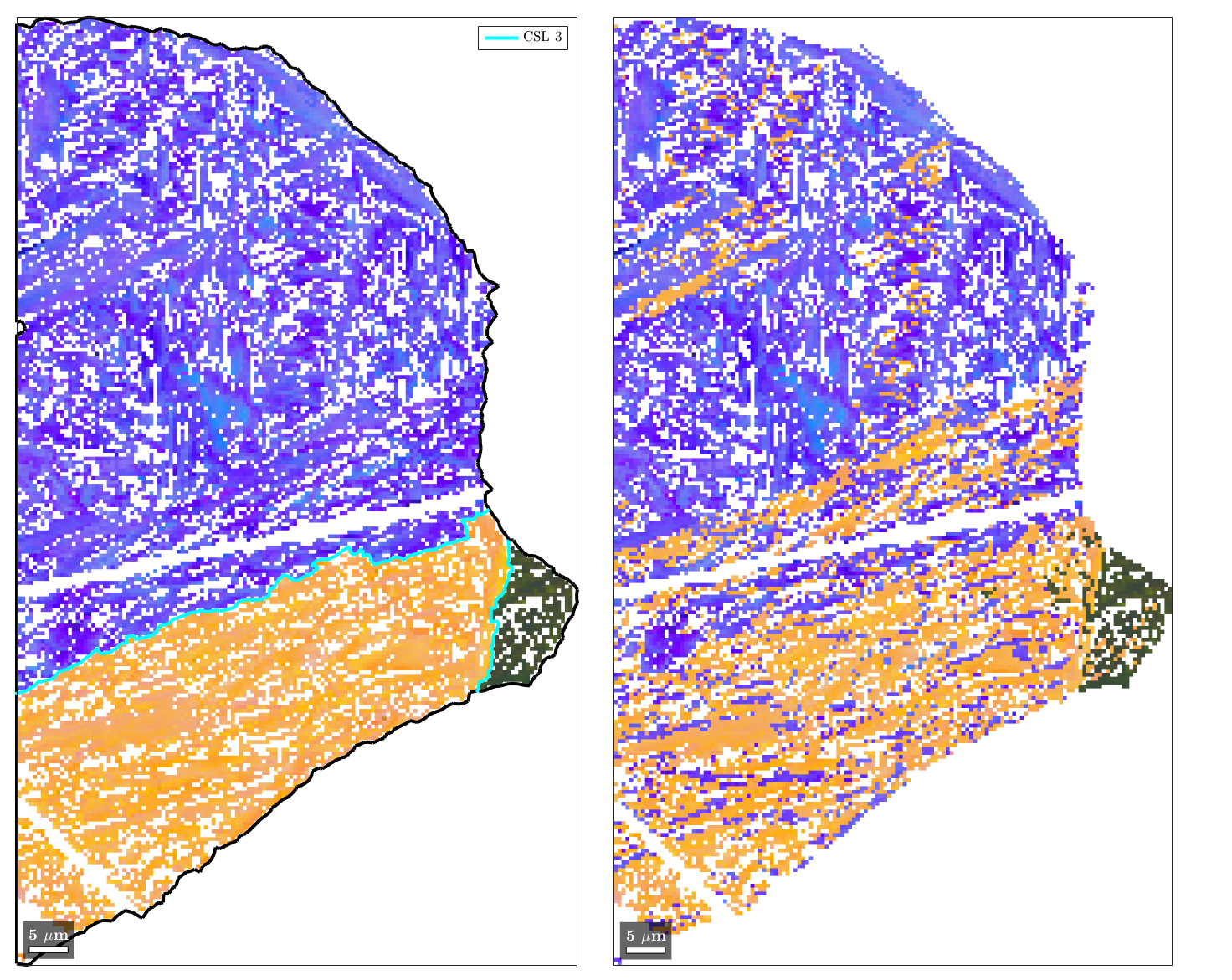
computeParentTwins
This function computes twins in parent grains by local refinement.
- Syntax
- computeParentTwins(job,pGrainId)
- Input
- job - @parentGrainreconstructor
- pGrainId - parent grain Id
- direction - @vector3d
- Options
- grains - plot grain data instead of EBSD data
computeVariantGrains
This function refines the child grains in the job object based on their variant IDs. It returns a grain object containing the refined child grains alongside all other grains and an EBSD object with updated grain Ids.
- Syntax
- [variant_grains,cEBSD] = computeVariantGrains(job,varargin)
- Input
- job - @parentGrainReconstructor
- Output
- grains - @grains2d
- ebsd - @EBSD
- Options
- parentGrainId - parent grain Id using the argument 'parentGrainId'
computeVariantPairGroups
This function automatically derives the complete list of crystallographic variant pair groups for an orientation relationship.
Two variant pairs belong to the same group when their misorientations are symmetrically equivalent.
For example, for the Kurdjumov-Sachs OR with 24 variants, all nchoosek(24,2) = 276 variant pairs are sorted into 16 groups, each of which is labelled by its V1-Vx representative(s).
The output is intended to be passed straight to the group option of the computeGrainPairs function.
Doing so counts every variant pair boundary in the map, whereas a manually defined grouping that only lists pairs containing V1 (for e.g. {[1 2],[1 3; 1 5],...}) discards the ~92% of boundaries in which V1 is not literally one of the two variants.
- Syntax
- [groupIds,groupLabels] = computeVariantPairGroups(job)
- [groupIds,groupLabels] = computeVariantPairGroups(p2c,'variantMap',vMap)
- Input
- job - @parentGrainReconstructor, or the parent-to-child @orientation relationship (p2c) directly.
- Output
- groupIds - @cell = a cell array of groups. Each cell holds an n x 2 array of variant id pairs whose misorientations are symmetrically equivalent.
- groupLabels - @cell = a cell array of labels, one per group, named after the V1-Vx representative(s) of the group (for e.g. 'V1-V2', 'V1-V3(V5)').
- Options
- threshold - The angular tolerance used to decide whether two misorientations are equivalent. (default = 0.5*degree)
- variantMap - The variant map to apply. Only used when the first input is a p2c @orientation; a @parentGrainReconstructor supplies its own job.variantMap.
D
defineORs
This auxiliary function defines an orientation relationship (OR) for a parent-child phase combination given in the job object as: - Parallel planes and directions in a GUI, or - Peakfitting of the parent-child boundary misorientation angle distribution.
- Syntax
- job = defineORs(job)
- Input
- job - @parentGrainReconstructor
- Output
- job - @parentGrainReconstructor
E
ensureFolder
This function creates the folder that filePath is written to, if that folder does not exist yet. Git does not track empty directories, so the subfolders of data/output are not guaranteed to be present in a freshly cloned repository.
- Syntax
- ensureFolder(filePath)
- Input
- filePath - full path of a file that is about to be written, or the path of the folder itself
F
fibreMaker
This function creates an ideal crystallographic fibre with a user specified half-width and exports the data as: - a lossless Mtex .txt file for MTEX v5.9.0 and onwards), or - a lossy discretised Mtex .txt file for MTEX up to v5.8.2) for later use.
- Syntax
- fibreMaker(crystalDirection,specimenDirection)
- Input
- crystalDirection - @Miller
- sampleDirection - @vector3d
- sampleSymmetry - @specimenSymmetry
- Options
- halfwidth - halfwidth for the ODF calculation
- export - (optional path and) name of the file
G
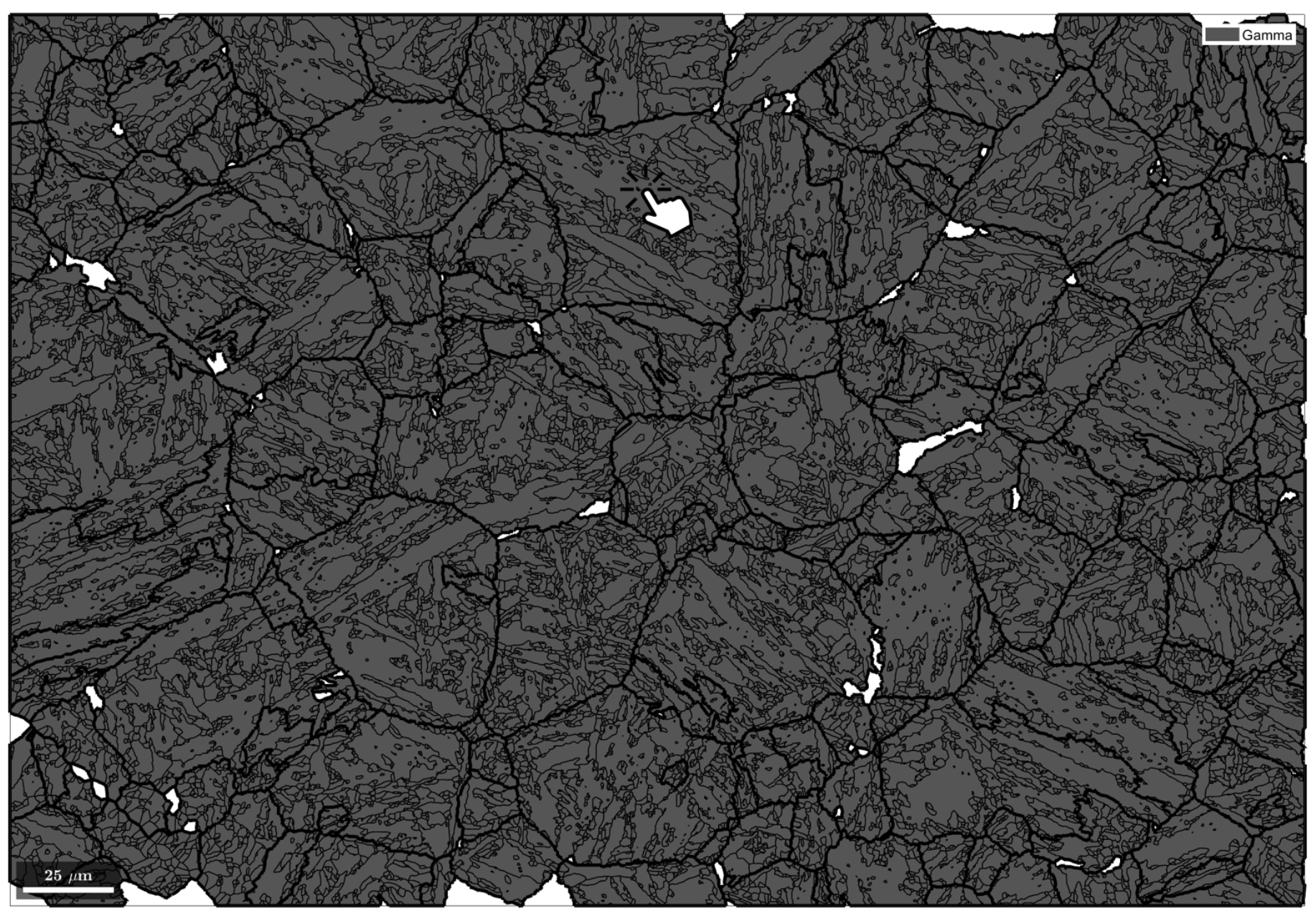
grainClick
This function produces a figure of an interactive ebsd map. It enables users to click on individual parent grains for detailed variant analysis.
- Syntax
- grainClick(job)
- Input
- job - @parentGrainReconstructor
- direction - @vector3d
- Options
- parentTwins - Refine grains to detect parent twins
- grains - Plot grain data instead of EBSD data
- noScalebar - Remove scalebar from maps
- noFrame - Remove frame around maps
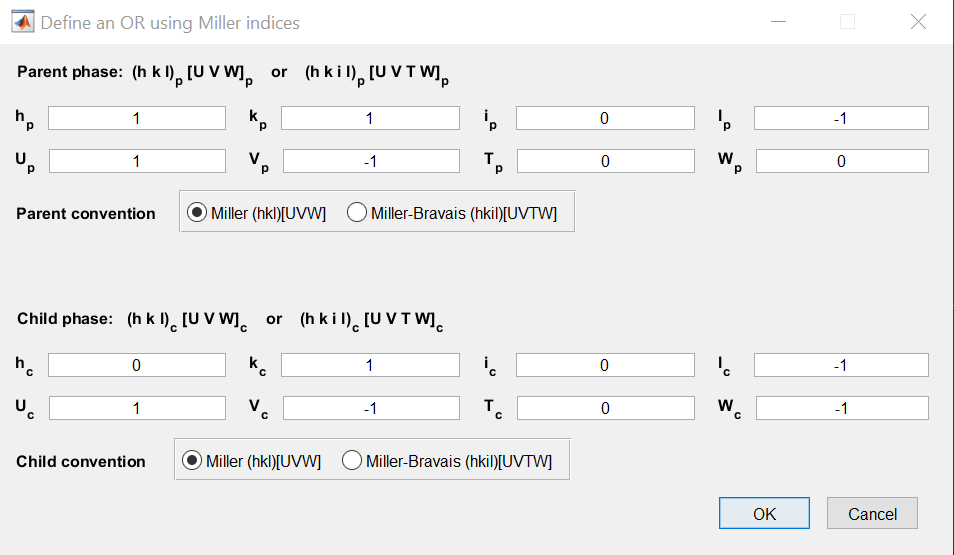
guiOR
This function is a GUI to to define an orientation relationship (OR) with parallel planes and directions.
- Syntax
- p2c = guiOR(job)
- Input
- job - @parentGrainReconstructor
- Output
- p2c - parent to child misorientation
O
orientationMaker
This function creates an ideal crystallographic orientation from a unimodal ODF with a user specified half-width and exports the data as a lossless Mtex .txt file for later use.
- Syntax
- orientationMaker(ori)
- Input
- ori - @orientation
- sampleSymmetry - @specimenSymmetry
- Options
- halfwidth - halfwidth for the odf calculation
- export - (optional path and) name of the file
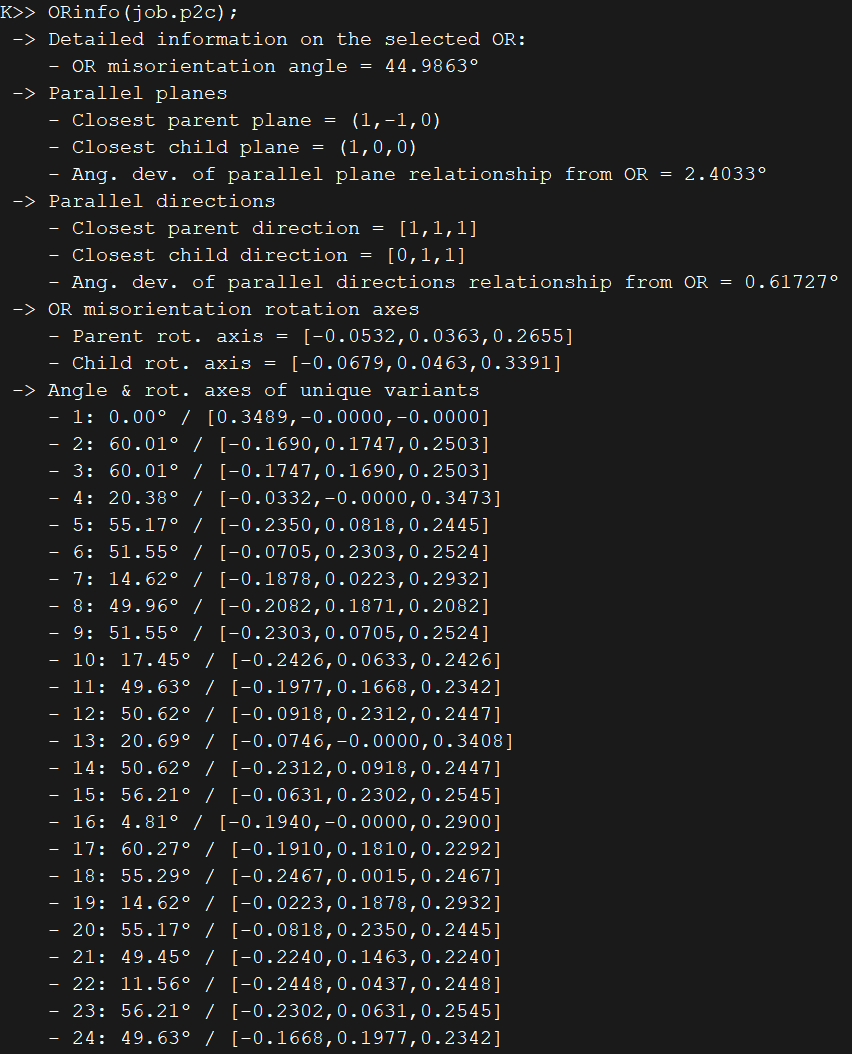
ORInfo
The function extracts orientation relationship (OR) information contained in the job.p2c structure variable and outputs it in the MATLAB command window.
- Syntax
- ORinfo(p2c)
- Input
- p2c - parent to child misorientation
- Output
- OR - structure containing OR information
- Options
- silent - suppress command window output
P
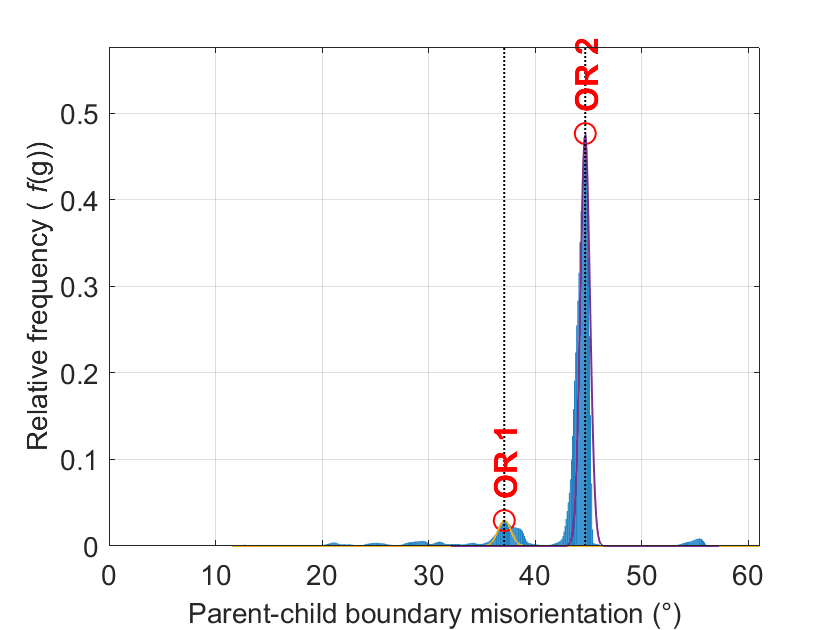
peakFitORs
This function peak fits parent-child misorientation angle ranges to determine one or several orientation relationships (ORs). The function is called by defineORs.
- Syntax
- p2c = peakFitORs(job,misoRange)
- Input
- job - @parentGrainReconstructor
- misoRange - range of misorientation angles in which to fit
- Output
- p2c - parent to child misorientation
plotCrystal_OR
This function plots the crystal orientation of a parent orientation and its child variants.
- Syntax
- plotCrystal_OR(job,oriP)
- Input
- job - @parentGrainReconstructor
- oriP - @orientation of the parent
- Options
- variantId - list with specific variant Ids to plot
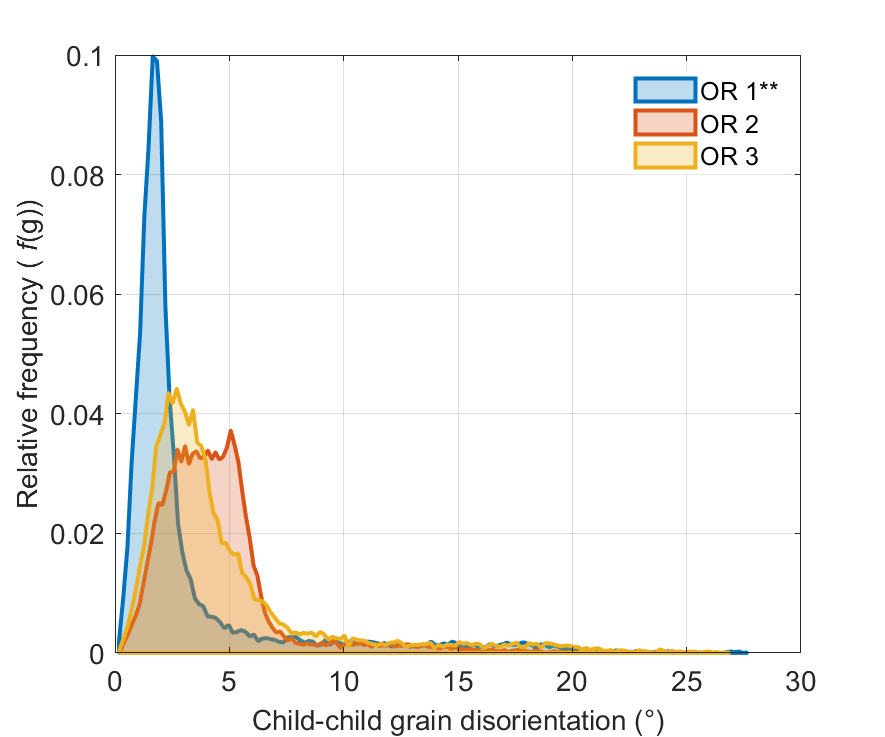
plotHist_OR_misfit
This function plots the disorientation, (or misfit), between parent-child and child-child grains and an orientation relationship (OR) in a histogram. By default, the current OR (job.p2c) is selected and is denoted by 2 stars (*). Additional ORs can be supplied with the argument p2c*.
- Syntax
- plotHist_OR_misfit(job)
- plotHist_OR_misfit(job,p2c)
- Input
- job - @parentGrainReconstructor
- p2c - one or multiple additional orientation relationship(s) to evaluate
- Options
- bins - number of histogram bins
- legend - cell array of strings with legend names of ORs to evaluate
plotIPDF_gB_misfit
This function plots the misfit, or disorientation, between parent-child and child-child boundaries sharing an orientation relationship (OR) in an inverse pole figure (IPF) showing the misorientation axes.
- Syntax
- plotIPDF_gB_misfit(job)
- Input
- job - @parentGrainReconstructor
- Options
- colormapP - colormap variable for parent grains
- colormapC - colormap variable for child grains
- maxColor - maximum color on color range [degree]
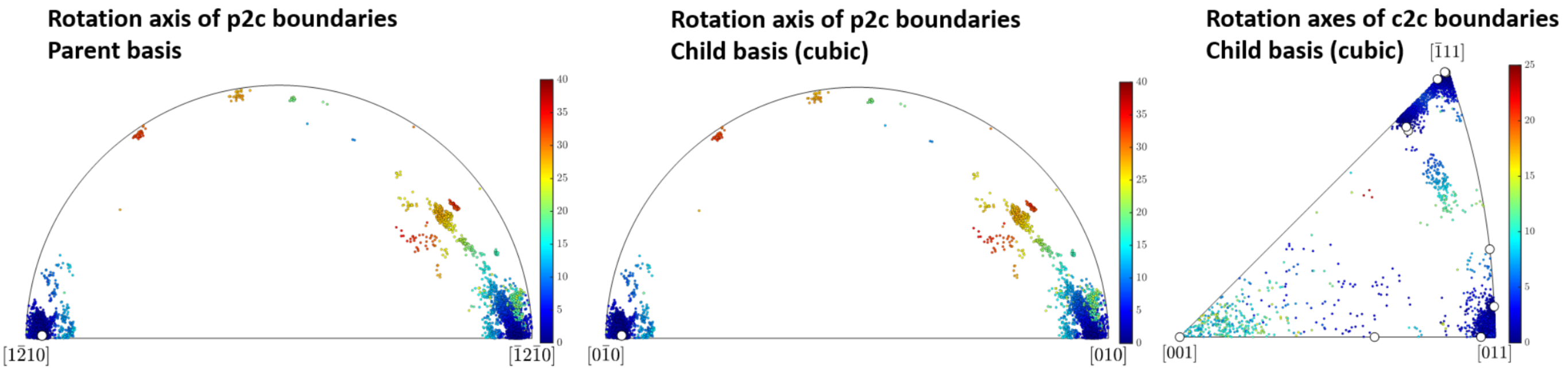
plotIPDF_gB_prob
This function calculates and plots the probability distribution, between 0 and 1, that a boundary belongs to an orientation relationship (OR) in an inverse pole figure (IPF) showing the misorientation axes.
- Syntax
- plotIPDF_gB_prob(job)
- Input
- job - @parentGrainReconstructor
- Options
- colormap - colormap variable
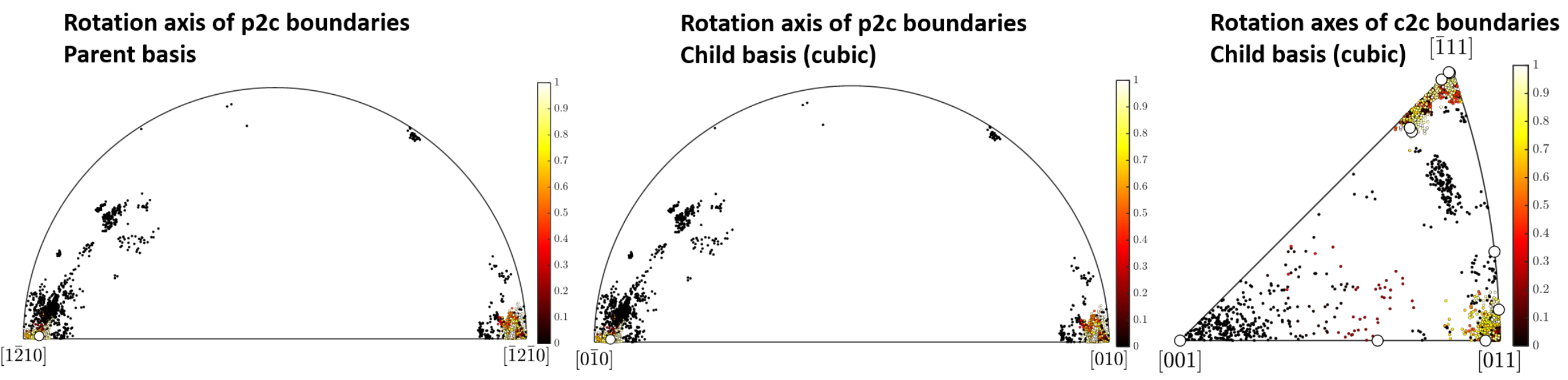
plotMap_bain
This function plots an ebsd map by colorising child grains according to their Bain group ID. It also outputs the area fraction of each Bain group.
- Syntax
- plotMap_bain(job)
- Input
- job - @parentGrainreconstructor
- Output
- f_area: Area fraction of each Bain group in the EBSD map
- Options
- colormap - colormap variable
- grains - plot grain data instead of EBSD data
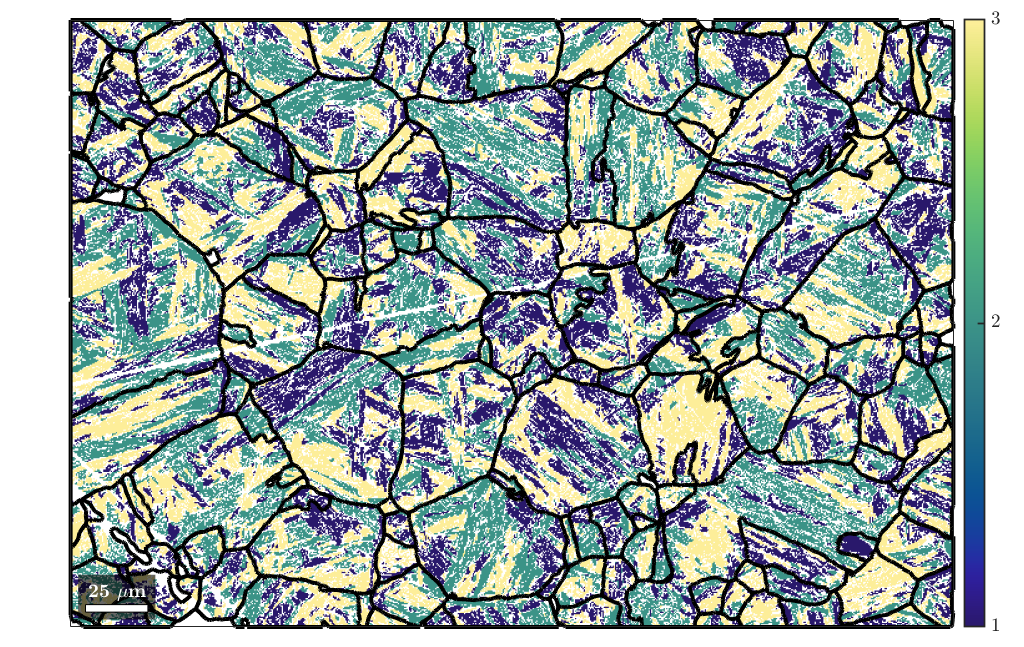
plotMap_blockWidths
This function calculates and plots an ebsd map of the representative value for martensite block widths by projecting all boundary points to the vector perpendicular to the trace of the {111}a plane as per the following reference:
Contributed by Dr. Tuomo Nyyssönen
- Syntax
- plotMap_blockWidths(job,varargin)
- Input
- job - @parentGrainreconstructor
- pGrainId - parent grain Id using the argument 'parentGrainId'
- Options
- noScalebar - Remove scalebar from maps
- noFrame - Remove frame around maps
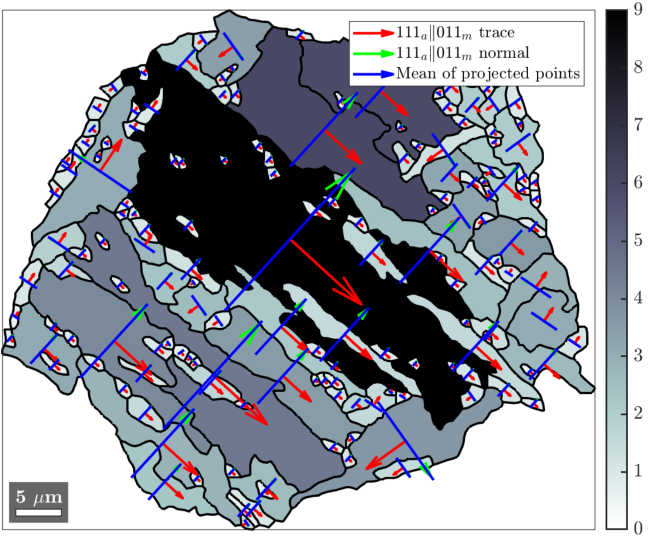
plotMap_clusters
This function plots an ebsd map of child grain clusters that are likely to belong to the same parent grain when clusterGraph is called. It is displayed as an overlay on top of a semi-transparent IPF map of child grains.
- Syntax
- ipfKey = plotMap_clusters(job)
- ipfKey = plotMap_clusters(job,direction)
- Input
- job - @parentGrainReconstructor
- direction - @vector3d - IPF direction
plotMap_gB_c2c
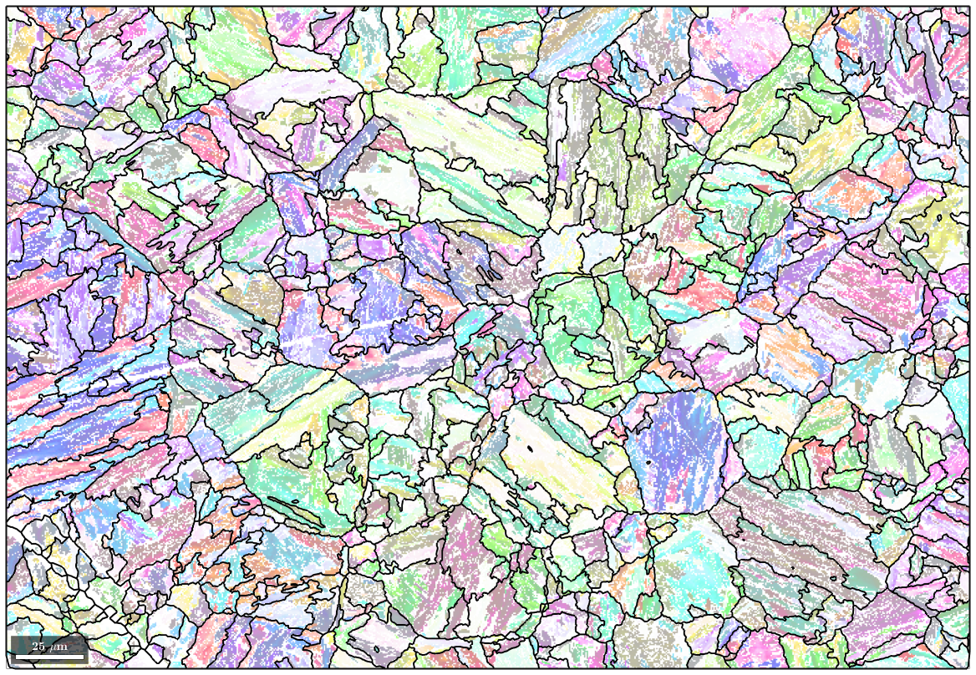
This function plots an ebsd map by colorising child-child boundary misorientations contained in the variable job.
- Syntax
- plotMap_gB_c2c(job)
- Input
- job - @parentGrainReconstructor
- Options
- colormap - colormap variable
plotMap_gB_misfit
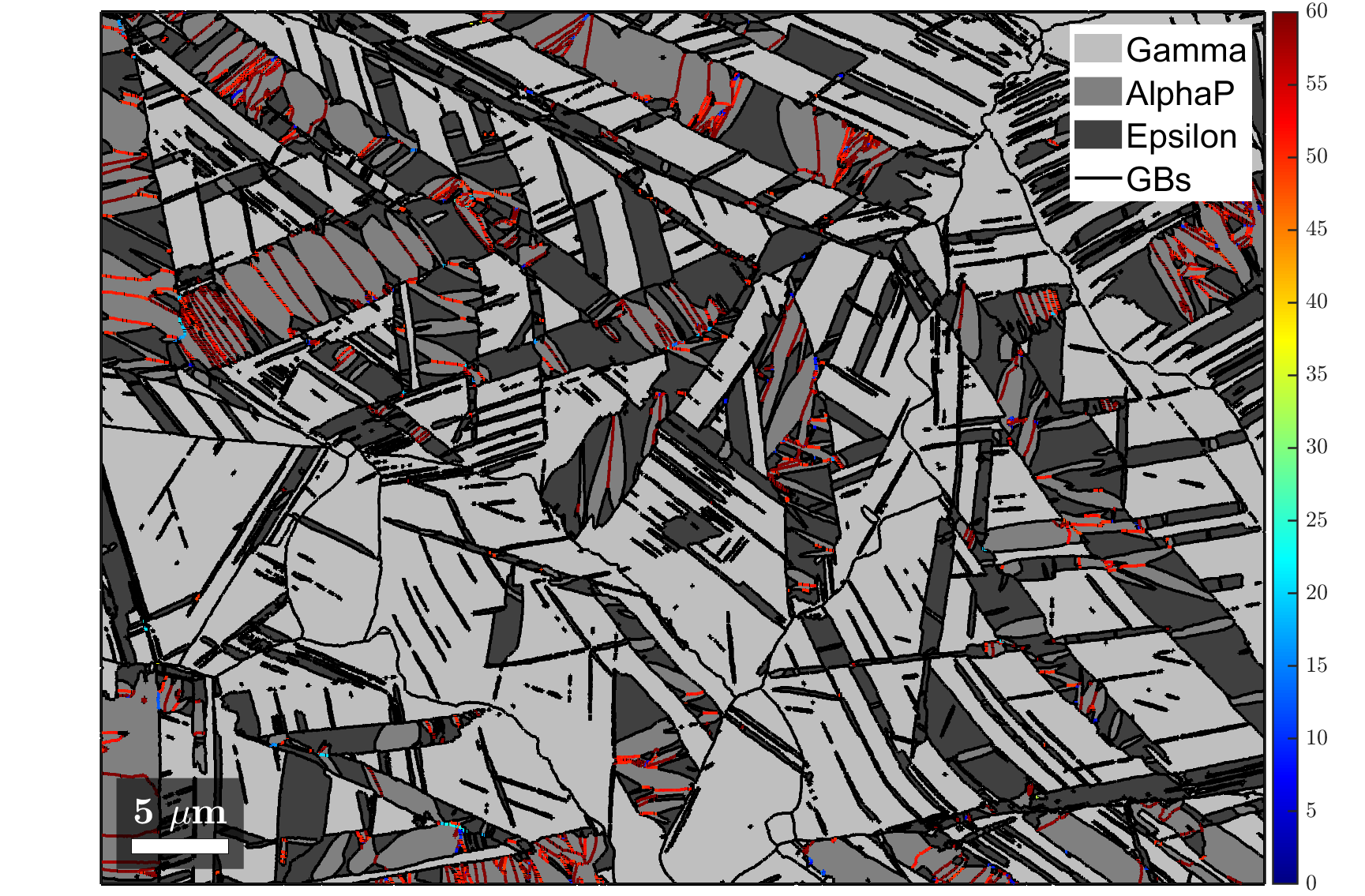
This function plots an ebsd map by colorising the misfit, or disorientation, between parent-child and child-child boundaries with the orientation relationship (OR) job.p2c
- Syntax
- plotMap_gB_misfit(job)
- Input
- job - @parentGrainReconstructor
- Options
- colormap - colormap variable
plotMap_gB_p2c
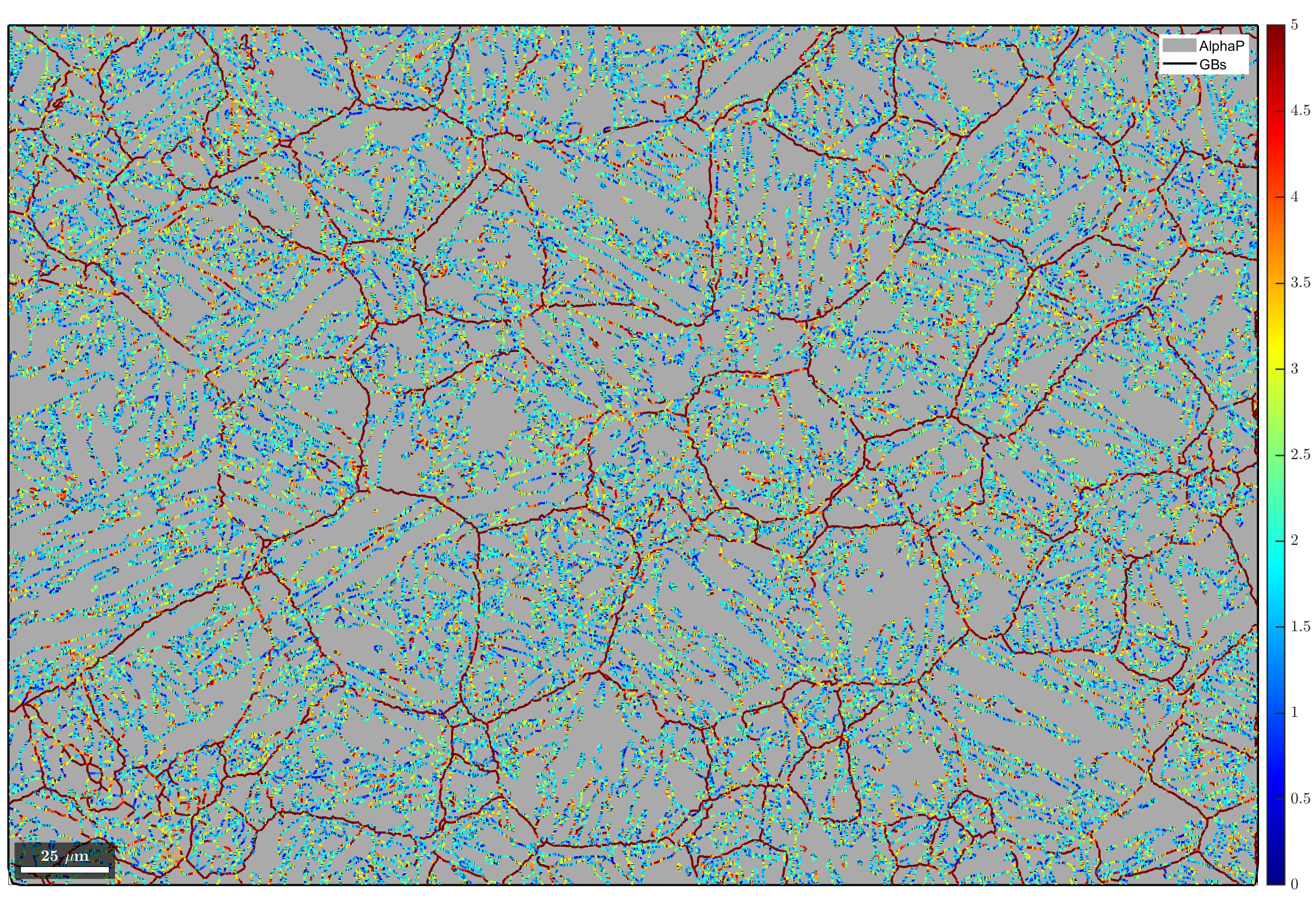
This function plots an ebsd map by colorising child-child boundary misorientations contained in the variable job.
- Syntax
- plotMap_gB_p2c(job)
- Input
- job - @parentGrainReconstructor
- Options
- colormap - colormap variable
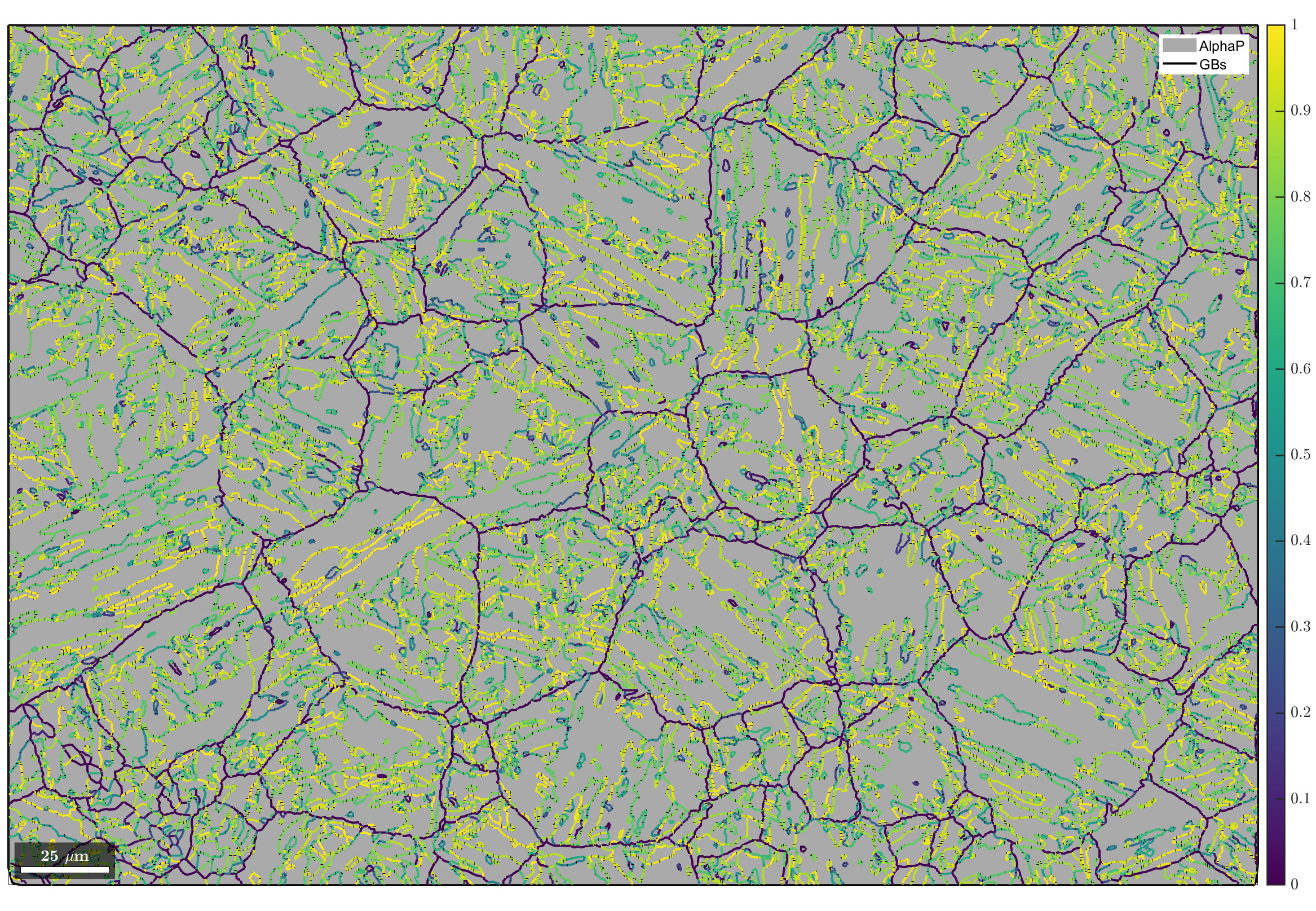
plotMap_gB_prob
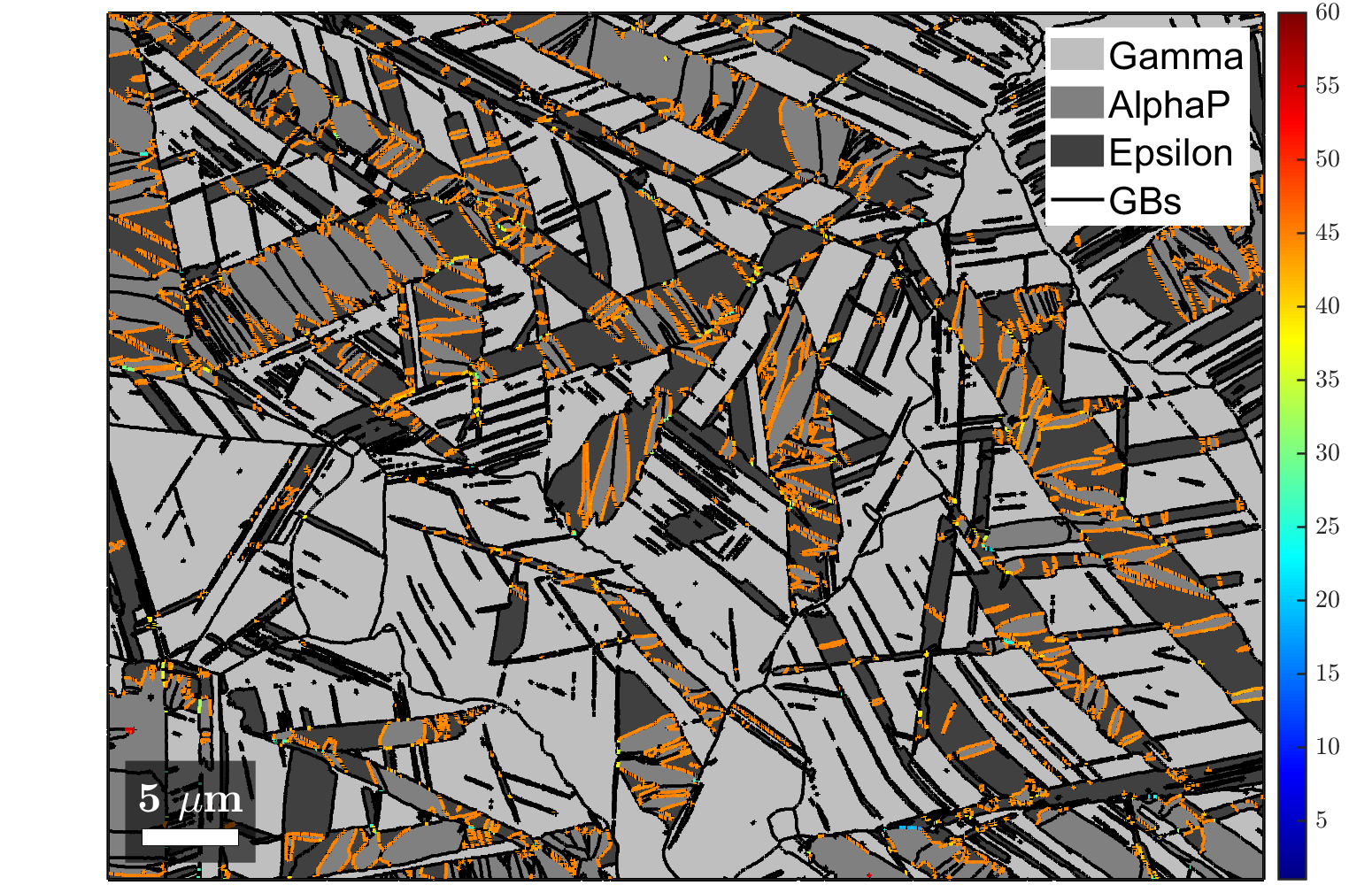
This function calculates and plots an ebsd map of the probability distribution, between 0 and 1, that a boundary belongs to an orientation relationship (OR). For more details, please click here.
- Syntax
- plotMap_gB_prob(job)
- Input
- job - @parentGrainReconstructor
- Options
- threshold - the misfit at which the probability is exactly 50 percent ...
- tolerance - ... and the standard deviation in a cumulative Gaussian distribution
- colormap - colormap variable
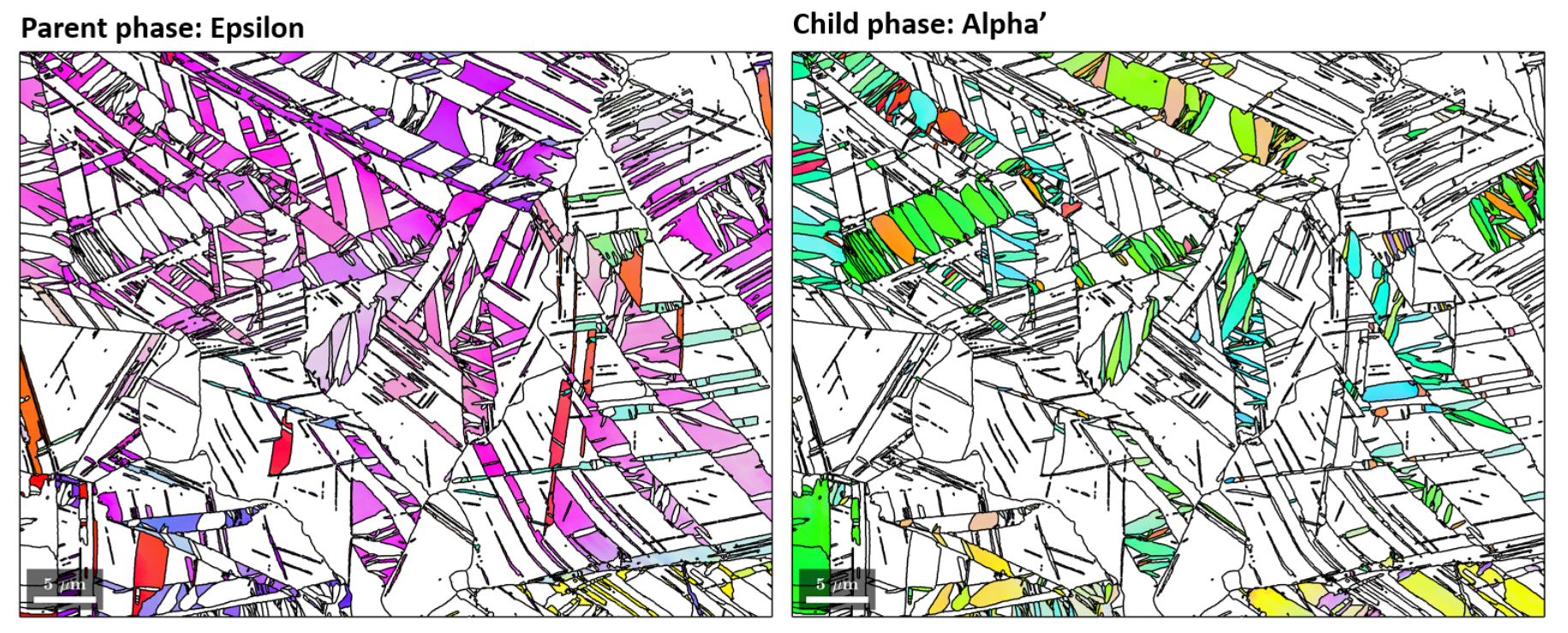
plotMap_IPF_p2c
This function plots inverse pole figure maps of the parent and child phases and returns the ipfHSV color key.
- Syntax
- plotMap_IPF_p2c(job)
- plotMap_IPF_p2c(job, direction)
- Input
- job - @parentGrainReconstructor
- direction - @vector3d
- Output
- ipfKey - @ipfHSVKey
- Options
- parent - plot only map of parent phase
- child - plot only map of child phase
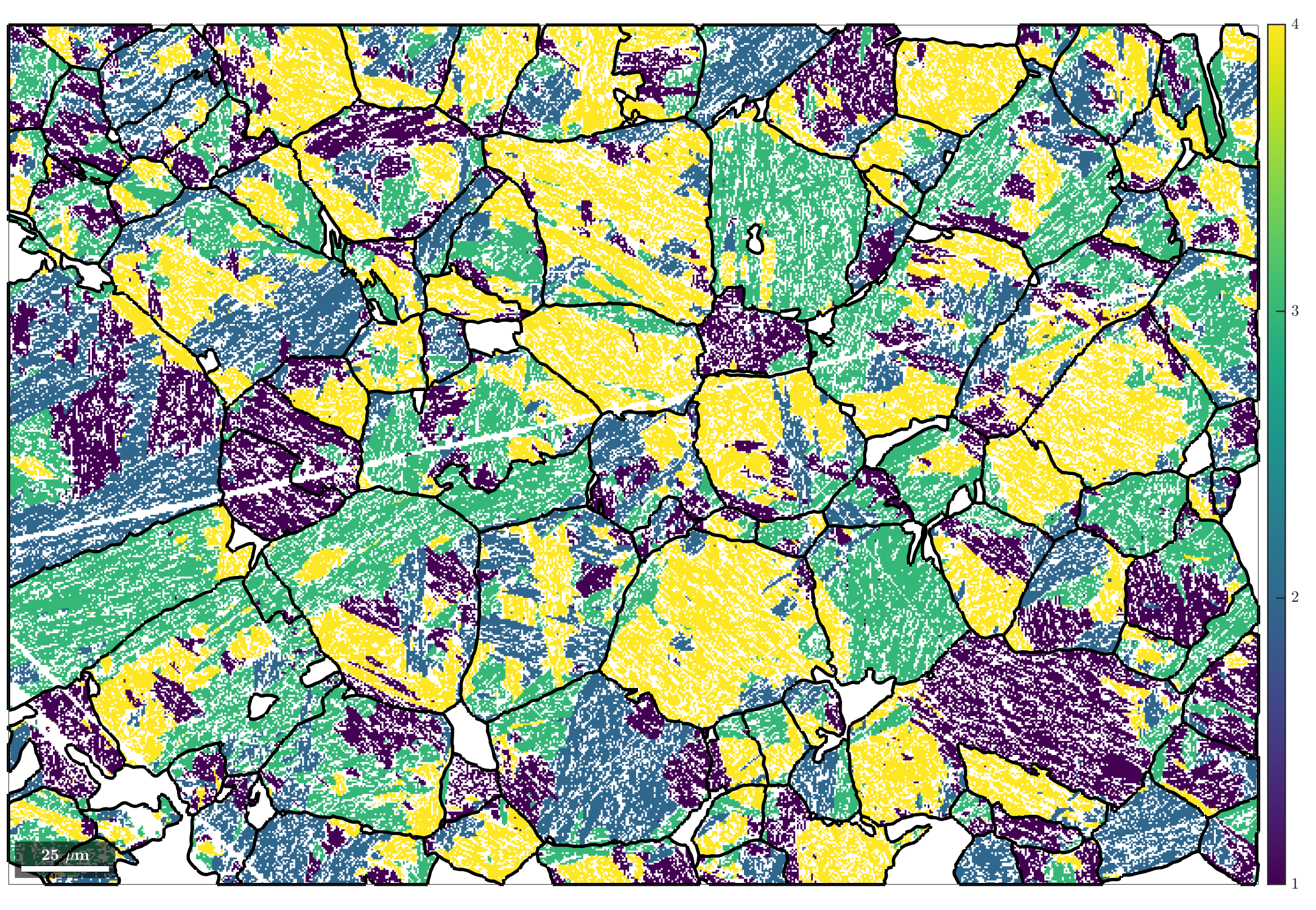
plotMap_packets
This function plots an ebsd map by colorising child grains according to their crystallographic packet ID. It also outputs the area fraction of each crystallographic packet.
- Syntax
- plotMap_packets(job)
- Input
- job - @parentGrainReconstructor
- Options
- colormap - colormap variable
- grains - Plot grain data instead of EBSD data
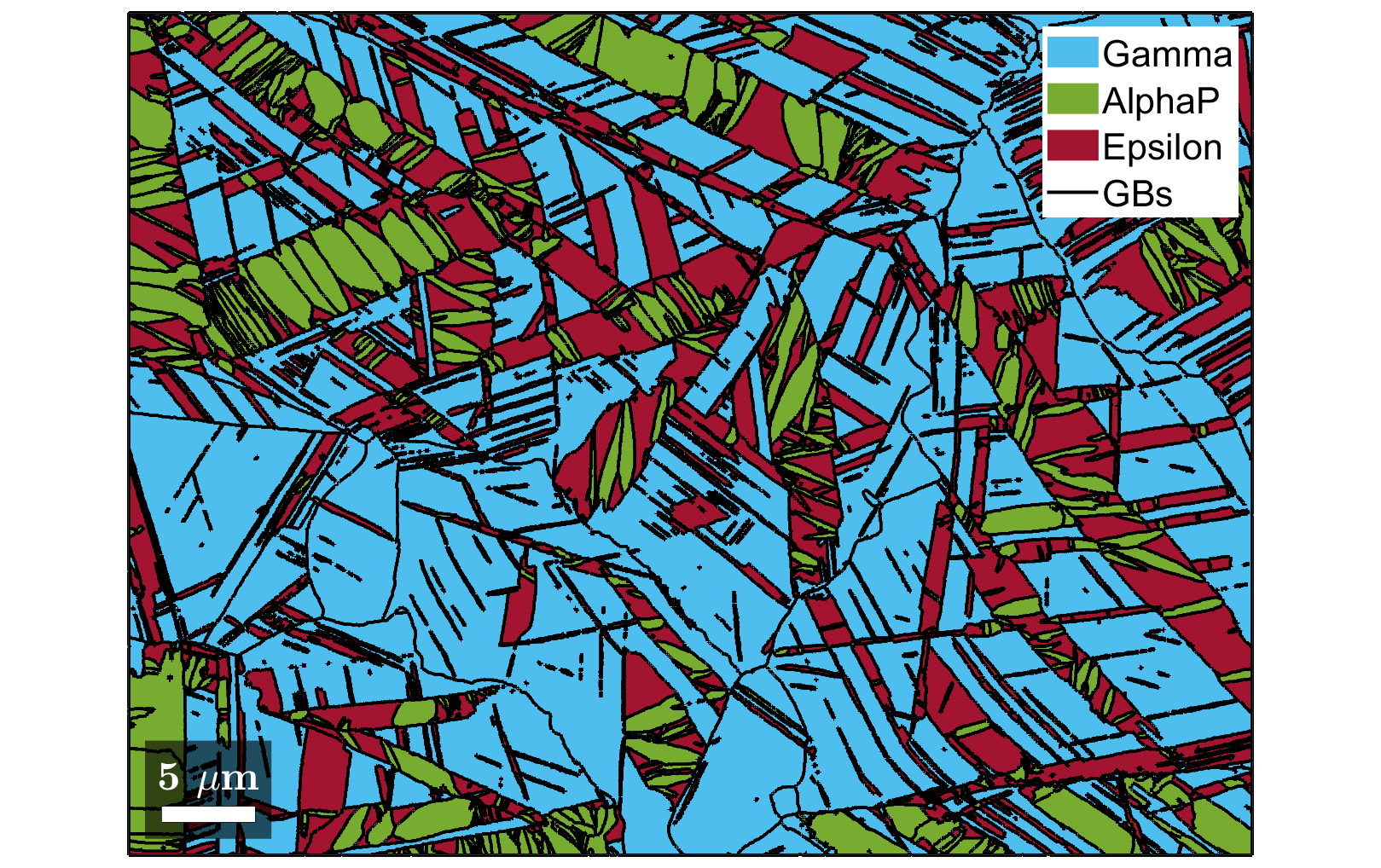
plotMap_phases
This function plots an ebsd map of the grain phases in the job variable as well as the grain boundaries (job.grains.boundary).
- Syntax
- p2c = plotMap_phases(job)
- Input
- job - @parentGrainReconstructor
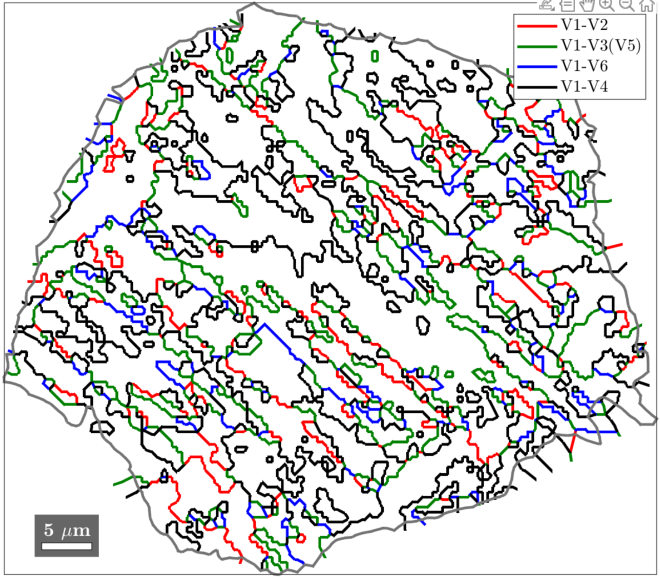
plotMap_KSvariantPairs
This function plots an ebsd map of the equivalent pairs of martensitic variants (block boundaries) within individual crystallographic packets in lath martensite microstructures as per the analysis in the following reference:
- Syntax
- variantPairs_boundary = plotMap_KSvariantPairs(job,varargin)
- Input
- job - @parentGrainreconstructor
- pGrainId - parent grain Id using the argument 'parentGrainId'
- Output
- variantPairs_boundary - a structure variable of the groups of equivalent variant pair boundaries
- Options
- include - Includes equivalent variant pairs between crystallographic packets
- noScalebar - Remove scalebar from maps
- noFrame - Remove frame around maps
plotMap_variants
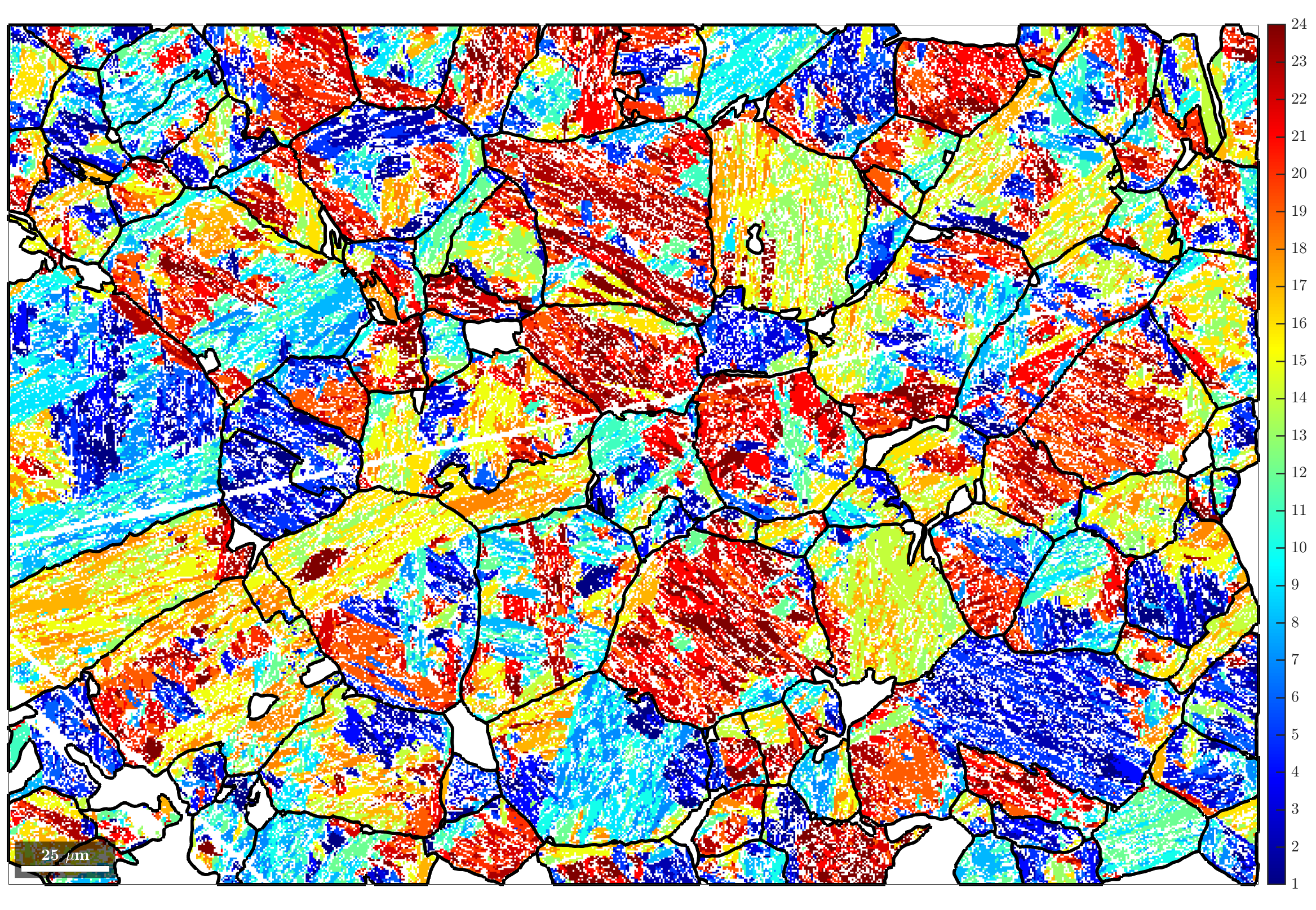
This function plots an ebsd map by colorising child grains according to their variant IDs. It also outputs the area fraction of each variant.
The function plots the map of child grains colored according to their variant ID.
- Syntax
- plotMap_variants(job)
- Input
- job - @parentGrainReconstructor
- Options
- colormap - colormap variable
- grains - Plot grain data instead of EBSD data
plotPDF_bain
This function plots a pole figure of the child Bain group IDs associated with an OR job.p2c.
- Syntax
- plotPDF_bain(job)
- plotPDF_bain(job,oriParent)
- plotPDF_bain(job,oriParent,pdf)
- Input
- job - @parentGrainreconstructor
- oriParent - @orientation
- pdf - @Miller
- Options
- colormap - colormap variable

plotPDF_packets
This function plots a pole figure of the child crystallographic packet IDs associated with an OR job.p2c.
- Syntax
- plotPDF_packets(job)
- plotPDF_packets(job, oriParent)
- plotPDF_packets(job, oriParent, pdf)
- Input
- job - @parentGrainReconstructor
- oriParent - @orientation
- pdf - @Miller
- Options
- colormap - colormap variable
- markersize - markersize
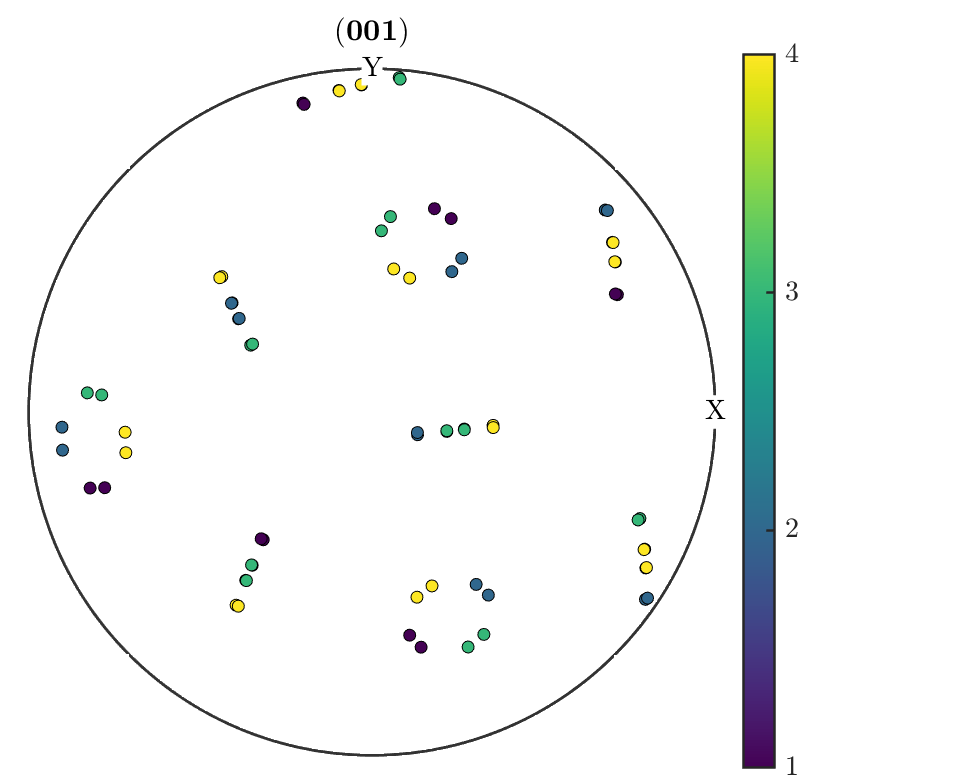
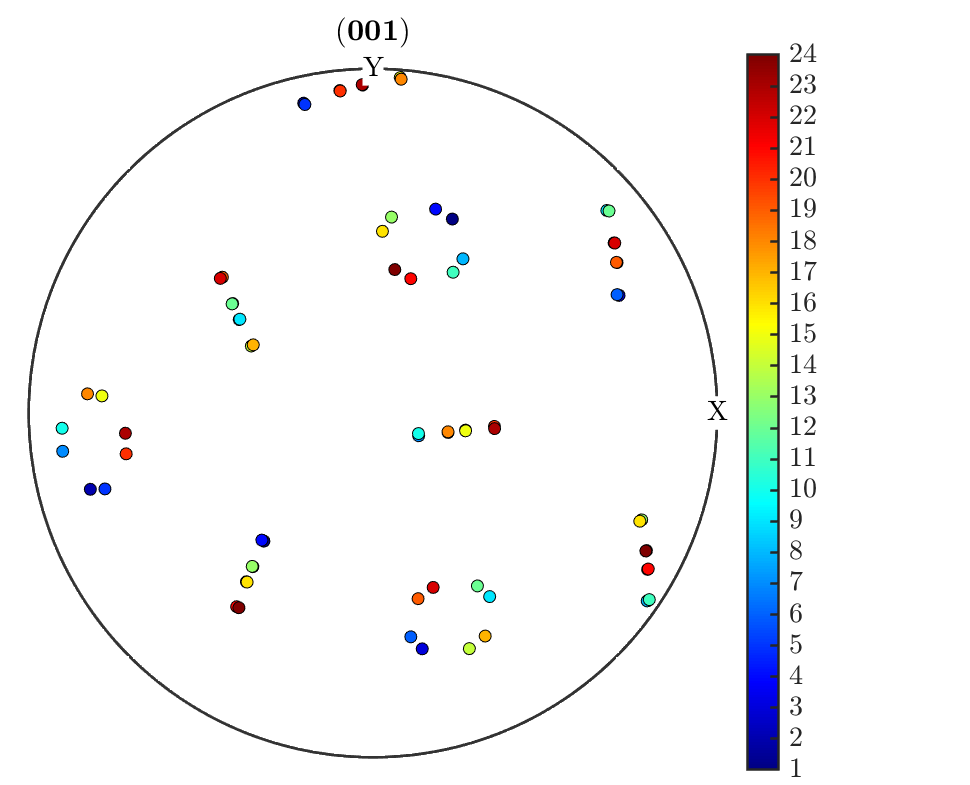
plotPDF_variants
This function plots a pole figure of the child variant IDs associated with an OR job.p2c. It is an alternative to MTEX's default plotVariantPF.
- Syntax
- plotPDF_variants(job)
- plotPDF_variants(job, oriParent)
- plotPDF_variants(job, oriParent, pdf)
- Input
- job - @parentGrainReconstructor
- oriParent - @orientation
- pdf - @Miller
- Options
- colormap - colormap variable
- markersize - markersize
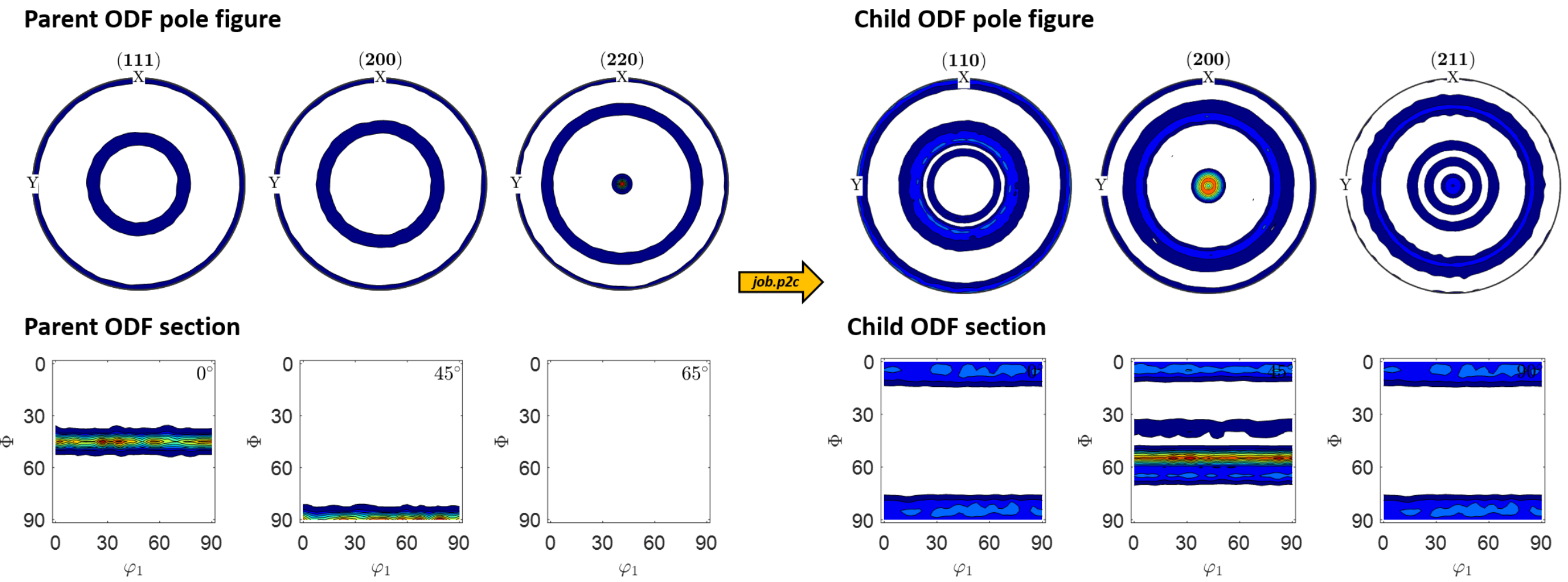
plotPODF_transform
The function calculates and plots the transformation texture, with or without imposing variant selection, based on a parent texture file. Input files can be created using: - ebsd map data as shown in example 4, - fibreMaker, or - orientationMaker.
- Syntax
- plotPODF_transformation(job,hParent,hChild)
- Input
- hParent - @Miller (parent pole figures to display)
- hChild - @Miller (child pole figures to display)
- Options
- odfSecP - array with angles of parent ODF section to display
- odfSecC - array with angles of child ODF section to display
- colormapP - colormap variable for parent PFs and ODFs
- colormapC - colormap variable for child PFs and ODFs
- variantId - list of specific variant Ids to plot
- variantWt - list of specific variant weights to plot
- halfwidth - halfwidth for PF calculation & display
- import - (optional path) & name of the input *.mat file to transform
- export - (optional path) & name of the output transformed *.mat file
plotStack
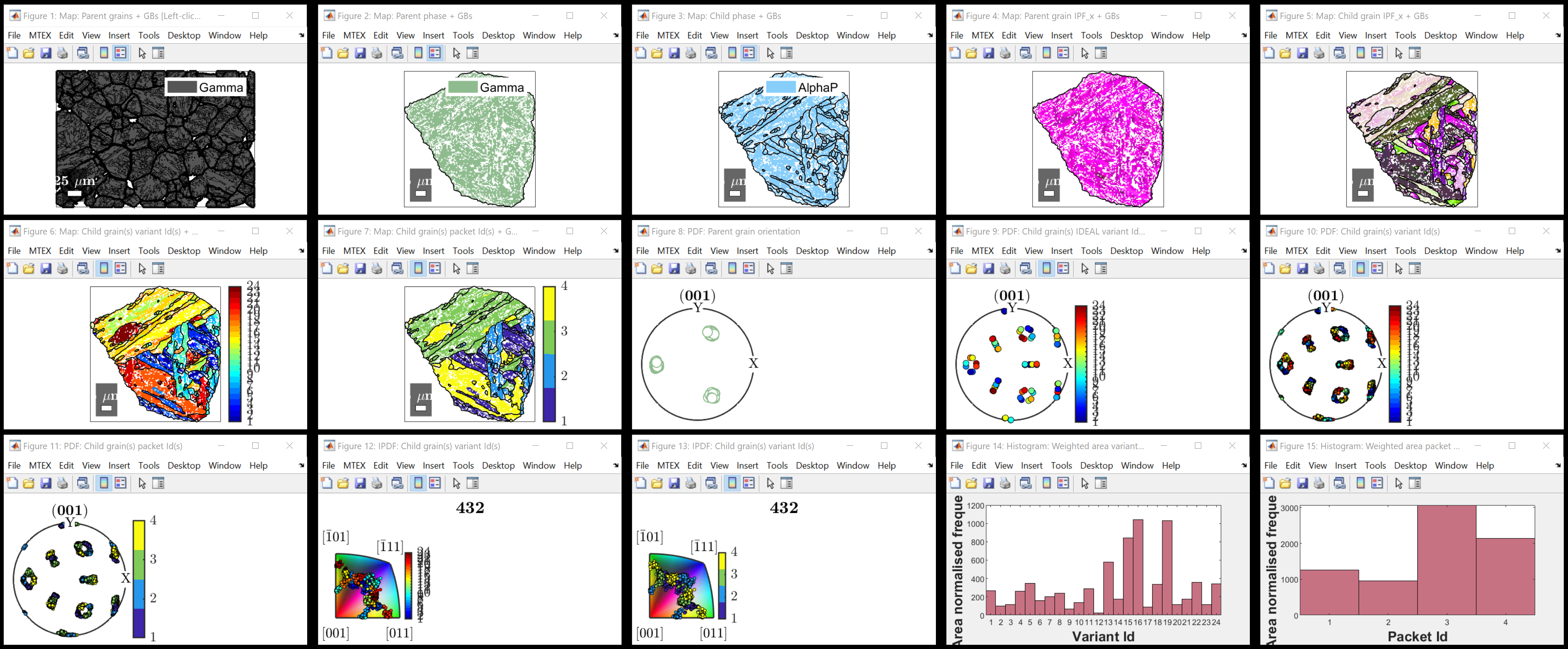
This function plots a series of maps, figures, graphs, and tables for detailed child variant analysis within a single parent grain as follows: - By manually supplying a parentGrainId, or - Using the grainClick function and interactively choosing a grain of interest.
- Syntax
- plotStack(job,pGrainId)
- Input
- job - @parentGrainreconstructor
- pGrainId - parent grain Id
- direction - @vector3d
- Options
- grains - Plot grain data instead of EBSD data
- noScalebar - Remove scalebar from maps
- noFrame - Remove frame around maps
R
readCPR
This function is a GUI to interactively load .cpr and .crc ebsd map data files into MTEX.
- Syntax
- ebsd = readCPR
- ebsd = readCPR(inPath)
- ebsd = readCPR(inPath, fileName)
- Input
- inPath - string with path to directory 'xx\yy\zz\'
- fileName - string with filename 'xxyyzz.cpr'
- Output
- ebsd - @EBSD
recolorPhases
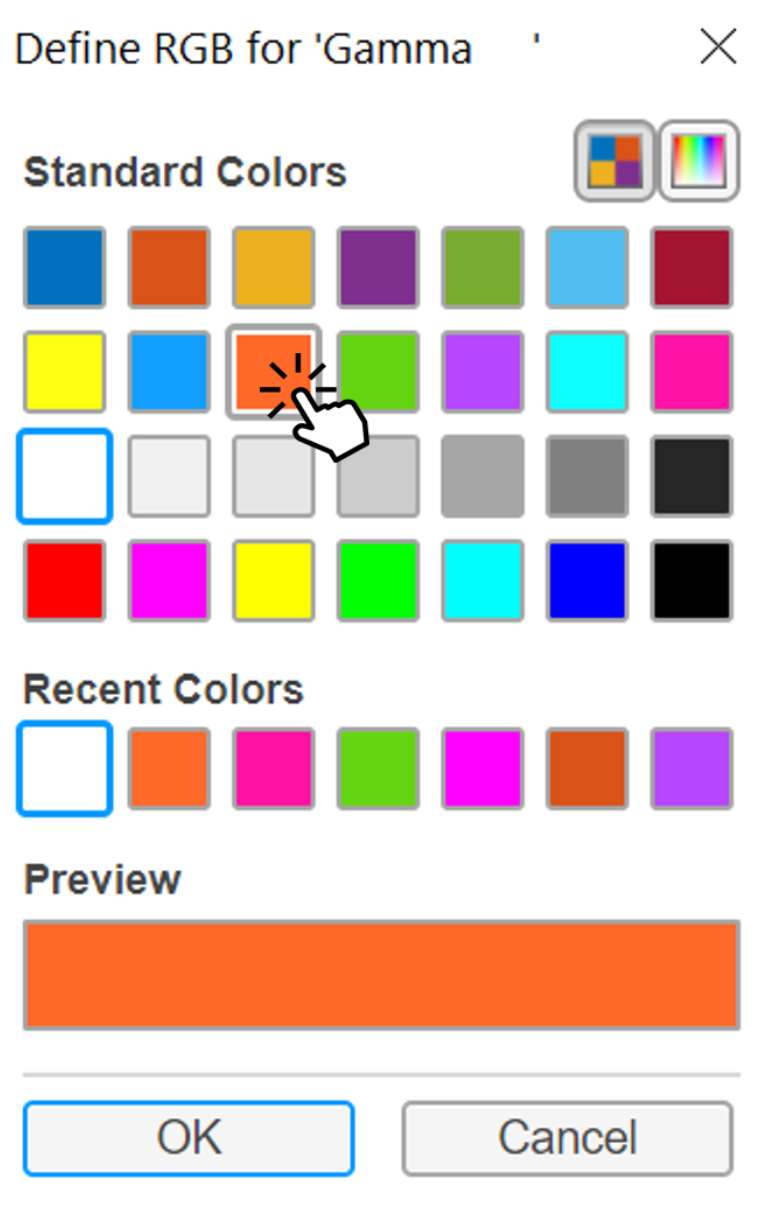
This function is a GUI to interactively recolor phases in the ebsd or grains variables.
- Syntax
- [ebsd] = recolorPhases(ebsd)
- [grains] = recolorPhases(grains)
- Input
- ebsd - @EBSD
- grains - @grains2d
- Output
- ebsd - @EBSD
- grains - @grains2d
renamePhases
This function is a GUI to interactively rename phases. It opens a list of phase names (pre-defined in phaseStrings) and renames each phase in the ebsd variable according to a user's selection.
- Syntax
- ebsd = renamePhases(ebsd,phStr)
- Input
- ebsd - @EBSD
- phaseStrings - cell array of strings with possible phase names
- Output
- ebsd - @EBSD
S
saveImage
This function saves all open figures as images.
- Syntax
- saveImage(fileDir,fileName)
- saveImage(fileDir)
- saveImage
- Input
- fileName - file name (string with file of type * .bmp, * .jpeg, * .png or * .tiff )
- fileDir - file directory
screenPrint
This function formats command window output.
- Syntax
- screenPrint(mode)
- screenPrint(mode, string)
- Input
- mode - formatting mode
- string - output string
setInterp2Latex
This function changes all MATLAB text interpreters from 'tex' to 'latex in all subsequent figures, plots, and graphs.
- Syntax
- setInterp2Latex
setInterp2Tex
This function changes all MATLAB text interpreters from 'latex' to 'tex in all subsequent figures, plots, and graphs.
- Syntax
- setInterp2Tex
setParentGrainReconstructor
This function is a GUI to define a job of class parentGrainReconstructor.
- Syntax
- setParentGrainReconstructor(ebsd,grains)
- setParentGrainReconstructor(ebsd,grains,inPath)
- Input
- ebsd - @EBSD
- grains - @grain2d
- inPath - string giving path to * .cif file folder
- Output
- job - @parentGrainReconstructor
T
tileFigures
This function tiles all figures evenly across the computer screen/monitor.
- Syntax
- fileFigs